What is Hyperledger?
Hyperledger is a complete suite of permissioned blockchain solutions allowing businesses to create distributed applications.


Since its creation in 2015 by the Linux Foundation, solutions from Hyperledger have been criticized for its permissioned nature, which marked a drastic shift from the approach of public blockchains like Bitcoin and Ethereum. This article describes Hyperledger and the primary problem it aims at solving. It also introduces the wide range of solutions and libraries under the Hyperledger umbrella (e.g., Fabric, Besu) to determine whether Hyperledger's tools can fit your needs.
Description
Hyperledger is a suite of open-source blockchain solutions, including multiple frameworks and tools, established by the Linux Foundation in 2015.Hyperledger is supported by companies, notably IBM, Intel, Accenture, Airbus, and some Japanese enterprises (e.g., Hitachi, NEC, Fujitsu).According to its charter, Hyperledger’s mission is to establish an open-source distributed ledger framework. It features a complete code base, serving business and enterprise needs, whereby users build and operate multiple “applications, platforms, and hardware systems to support business transactions”. Furthermore, the teams from Hyperledger aim to bolster the growth of a technical open-source community, working with companies in the ecosystem dedicated to growing the use of distributed ledgers for business applications.
What problems do Hyperledger attempt to solve?
Hyperledger finds roots in the Linux Foundation’s acknowledgment that blockchains are capable of improving data transparency and solving existing trust issues, yet, these were hindered by political views owing to the status of an underlying cryptocurrency (e.g., "ETH", "BTC").Hence, Hyperledger’s mission focuses on the development of an umbrella of multiple open-source solutions, including stand-alone products, libraries, and other tools to foster the use of blockchain technology across a wide variety of businesses.
Figure 1 - Hyperledger range of solutions, libraries, and other tools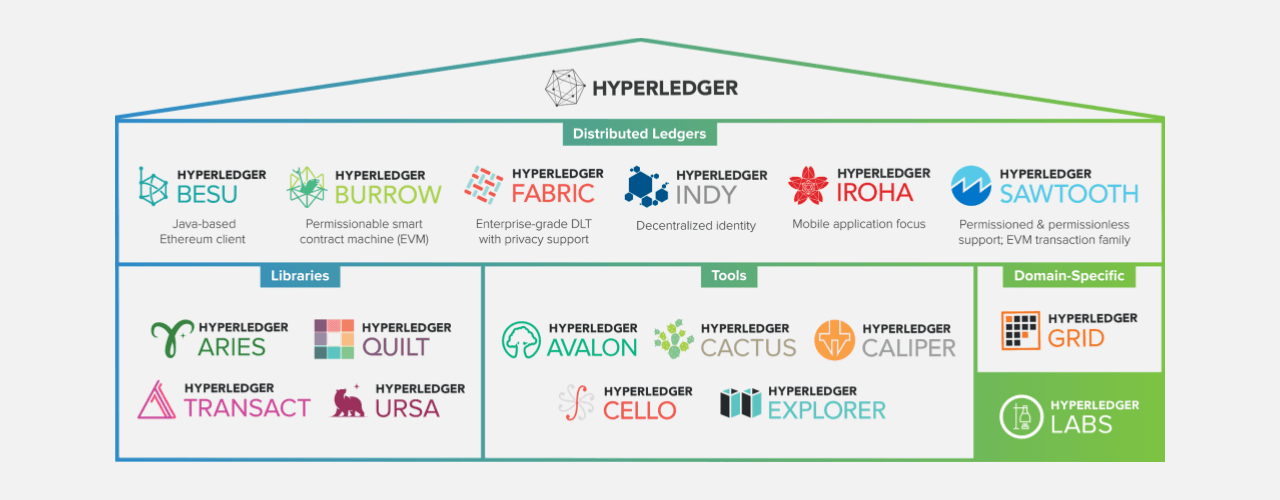 Source: Flying Block, Hyperledger. Hyperledger is comprised of multiple distributed ledger solutions, toolkits, and libraries.
A look at Hyperledger’s distributed ledger solutions
Unlike protocols like Baseline, the whole suite of open-source solutions from Hyperledger rely mostly on permissioned networks, with participant identities clearly stated, yet, with some exceptions. Hyperledger is developing six open-source blockchain solutions: Fabric - the most popular solution from Hyperledger. Fabric is a stand-alone distributed ledger enterprise solution built around the concepts of modularity and flexibility to cater for a wide range of use cases. Besu - an Ethereum client, targeting enterprises, for use cases including public and private permissioned networks.
- Sawtooth — A distributed ledger with an architecture purposely separating the core system from the application domain. Each set of smart contracts operate independently from the core system architecture, allowing flexibility for unique business needs.
- Burrow — A single-binary blockchain distribution with a focus on simplicity, speed, and developer ergonomics, supporting multiple virtual machines (e.g., EVM, WASM).
- Indy — A complete library with tools and various components that allow the management of identities on blockchains, across multiple applications. While fully interoperable with other blockchains, it is also usable as a stand-alone solution to power a permissioned identity management network.
- Iroha — With a focus on Internet of Things (“IoT”) use cases, Iroha is a distributed ledger with a focus on simplicity and easiness to integrate into IoT projects.
Summary of Hyperledger’s set of blockchain architecture
| Product | Description | Smart contract | Use cases | Consensus | Nature |
|---|---|---|---|---|---|
| Fabric | A stand-alone permissioned DLT for enterprises. | Go, Java | Whitelabel enterprise solutions | Flexible | Private/Permissioned |
| Besu | A Java-based permissioned version of Ethereum, with added privacy options | Solidity, DAML (EVM) | Whitelabel enterprise solutions | PoW, PoA (IBFT/Clique) | Public or Private/Permissioned |
| Sawtooth | A distributed ledger separating the core architecture and smart contracts | Python, JavaScript, Go, C++, Java,"Rust Solidity" (with Sawtooth-EVM) | General public | PoET, PoA (RAFT/PBFT) | Public or Private/Permissioned or Permissionless |
| Burrow (Incubation) | A single-binary permissioned EVM-compatible blockchain | Solidity (EVM) Experimental languages (WASM) | Lightweight product supporting EVM-compatibility with Tendermint. | PoET, PoA(RAFT/PBFT) | Public or Private/Permissioned or Permissionless |
| Indy | A library for identity management, featuring the use of zero-knowledge proof. | - | Identity management solution that can be referenced by smart contracts in blockchains. Can also be implemented as a stand-alone solution. | ||
| Iroha | A permissioned distributed ledger for IoT projects | C++ | Lightweight network built for Internet of Things and other mobile applications. | YAC (Yet Another Consensus) - a distinct vote-based consensus mechanism | Private/Permissioned |
Other libraries and tools from Hyperledger
Besides the above range of distributed ledger solutions, Hyperledger also features a set of libraries and tools.
Hyperledger libraries
As of writing, there are five core libraries from Hyperledger:
- Aries - A shared, reusable, and interoperable toolkit that is designed for digital credentials. Aries focuses on solutions to create, transfer, and store credentials.
- Grid — A standardized set of implementations for supply chain use-cases, which cover data types, data models, and smart-contract business logic.
- Quilt — An implementation of the Interledger protocol in Java, i.e., an open protocol suite for sending payments across different ledgers.
- Transact — A standard interface for smart contract execution that is separate from the distributed ledger implementation (introducing the concept of “smart contract engines”).
- Ursa — A shared cryptographic library for Hyperledger and non-Hyperledger ledgers. It implements mechanisms to avoid duplicating other cryptographic work and subsequently increase security in blockchain processes.
Hyperledger tools
As of writing, there are five primary tools from Hyperledger:
- Avalon — An implementation tool of the Trusted Compute Specifications published by the Enterprise Ethereum Alliance.
- Cactus — An integration tool designed to allow individuals to incorporate different blockchains into their respective business processes.
- Caliper — A benchmark tool dedicated to blockchain performance analysis. It allows individuals to measure the performance of a specific blockchain implementation based on a subset of defined use cases.
- Cello — An on-demand “as-a-service” ("AAS") deployment model for any blockchain aimed at reducing all the effort required for creating, managing, and terminating blockchains.
- Explorer — This offers tools for users to view, query, and monitor blocks, transactions, and data, along with other information such as metrics about transactions or the network itself.
Should I use Hyperledger?
As of today, Hyperledger is the largest umbrella of open-source blockchain solutions tailored to enterprise use cases. With more than a dozen products, including libraries, tools, and other white-label blockchains, the Hyperledger suite attempts to cater to a large number of use cases in multiple real-world industries such as supply chain, real estate, and financial services. Furthermore, large companies have been implementing solutions for it, mostly on Fabric. Notably, IBM, the technology giant, solely relies on Hyperledger solutions for its blockchain range of activities. However, there might be multiple drawbacks due to this diversity of offerings. Amongst them, some are:
- Unequal development stages between products — While products like Fabric are fully enterprise-ready, others are still in relatively nascent stages, with smaller communities, and several pending (unresolved) issues according to our analysis of their GitHub public repositories. Similarly, code coverage varies greatly amongst solutions.
- “Winner takes all” — Since the Hyperledger suite of products is large, developers would likely prefer to focus on a subset of products, due to network effects. In comparison, competing products like Quorum or Corda have a single product that bolsters a development community.
- High learning curves — All products are native implementations, leading to learning curves for third-party developers in the blockchain industry. The main exception is Hyperledger Besu that is forked from the Ethereum Java source code, which has, unfortunately, been deprecated. In comparison, a solution like Quorum is built as a fork of “go-ethereum”, making it easy to incorporate future improvement from Ethereum’s public source code. As Hyperledger’s foundation rejects the “one size fits all” idea, most of your needs likely have a solution in the Hyperledger suite.
Read more about similar topics
